Liquid vs. Hydrogen: The Ultimate Decision Matrix for Your Shopify Store
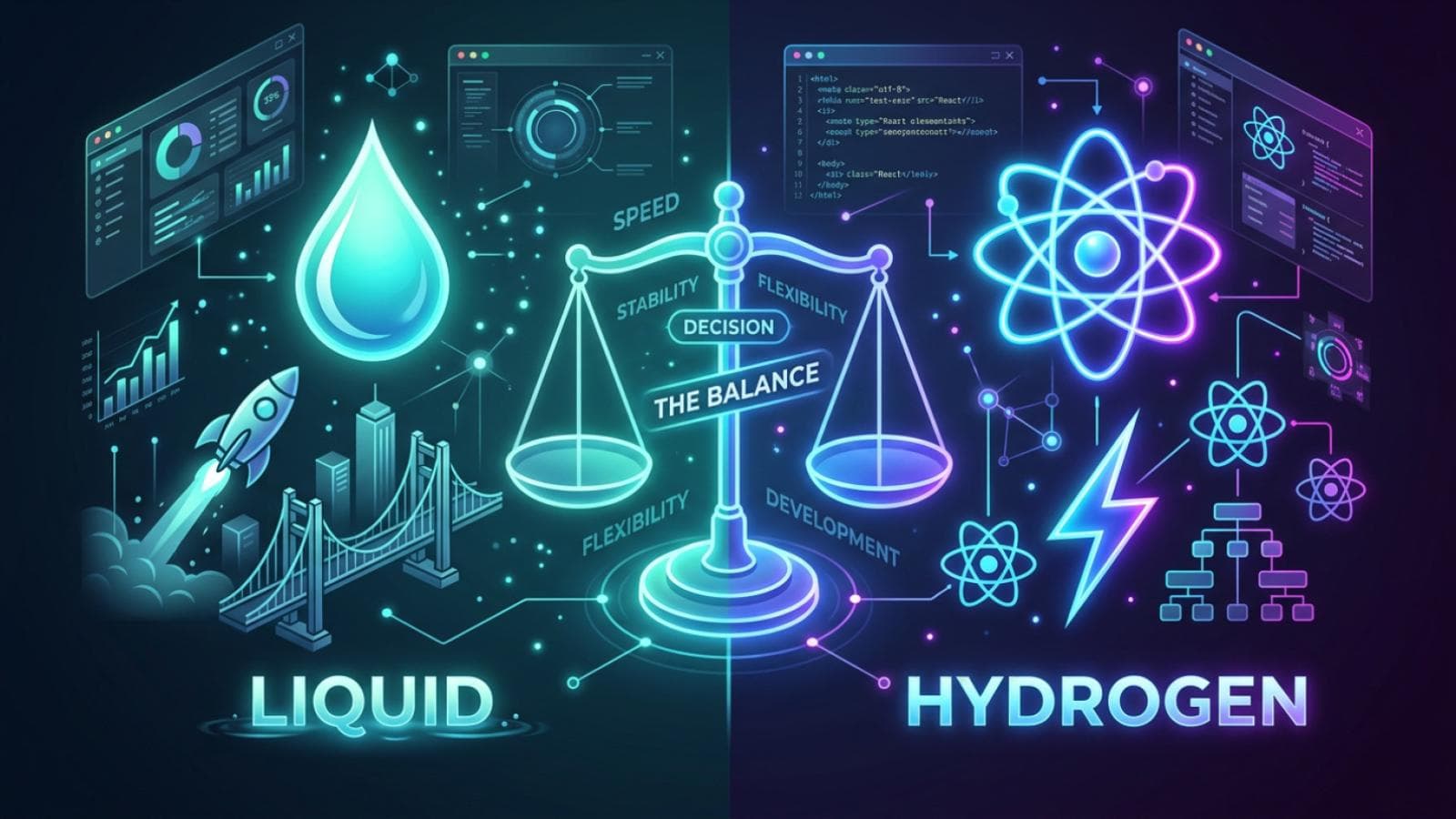
In the rapidly evolving world of e-commerce, the technical foundation of your store is no longer just a "development choice"—it is a strategic business decision. For years, Shopify’s Liquid templating engine has been the undisputed gold standard for building reliable, beautiful, and functional online stores. However, the rise of "Headless Commerce" and the introduction of Shopify Hydrogen (powered by React and Remix) have shifted the paradigm.
At Prateeksha, we often encounter brand owners standing at a crossroads: Should they stick with the tried-and-true Liquid architecture, or is it time to leap into the futuristic, high-performance world of Hydrogen?
1. Understanding the Contenders
What is Shopify Liquid?
Liquid is Shopify's native, Ruby-based templating engine. It follows a "coupled" architecture where the frontend (what the user sees) and the backend (the Shopify admin) are tightly integrated. It is the engine behind every theme on the Shopify Theme Store.
The Vibe: Stability, speed-to-market, and a "built-in" feel.
Best For: Small to mid-market brands looking for reliability and ease of management.
What is Shopify Hydrogen?
Hydrogen is Shopify’s official framework for building headless storefronts. It utilizes React and the Remix framework to allow developers to build a completely custom frontend that talks to Shopify via the Storefront API. The site is then hosted on Oxygen, Shopify’s global hosting solution.
The Vibe: Extreme performance, total design freedom, and developer-centric flexibility.
Best For: High-growth brands, enterprise-level scaling, and unique UX requirements.
2. The Decision Matrix: 5 Key Pillars
To help you decide, we evaluate both technologies across five critical business pillars: Performance, Customization, Cost of Ownership, SEO, and Future-Proofing.
Pillar 1: Performance and User Experience (UX)
Liquid:
Liquid themes are generally fast, especially with the introduction of Online Store 2.0. However, because the server has to "render" the page every time a user clicks a link, there is always a slight delay. As you add more apps and scripts, Liquid themes tend to slow down, often referred to as "theme bloat."
Hydrogen:
Hydrogen is built for speed. Because it is a Single Page Application (SPA), only the data changes when a user navigates—the page doesn't fully reload. This results in "instant" transitions that feel more like a mobile app than a website.
The Winner: Hydrogen, for brands where every millisecond of load time directly impacts multi-million dollar conversion goals.
Pillar 2: Design and Customization Freedom
Liquid:
You can achieve incredible designs in Liquid (at Prateeksha, we specialize in pixel-perfect Liquid builds). However, you are ultimately bound by Shopify’s URL structure and logic. If you want a highly non-standard checkout flow or a unique experience that blends a blog and a store seamlessly, Liquid can sometimes feel restrictive.
Hydrogen:
With Hydrogen, the "head" (frontend) is detached. You can build whatever you can imagine in React. This is ideal for brands that want to integrate content from different sources (like a separate CMS) or create interactive 3D product builders that would be too heavy for a traditional theme.
The Winner: Hydrogen, for brands with visionary UI/UX requirements.
Pillar 3: Cost and Time-to-Market
Liquid:
Liquid is significantly more cost-effective. Because the infrastructure is already there, development is faster. Most Shopify apps work "out of the box" with Liquid, meaning you don't need custom code to integrate reviews, loyalty programs, or search bars.
Hydrogen:
Hydrogen development is more complex and requires specialized React developers. Furthermore, many third-party apps do not have a "headless" integration ready, meaning your developers may need to build custom API connections for every app you use. This increases both initial build costs and ongoing maintenance.
The Winner: Liquid, for brands focused on ROI and faster deployment.
Pillar 4: SEO and Technical Marketing
Liquid:
Shopify’s Liquid themes are built for SEO. Metadata, sitemaps, and canonical tags are handled automatically. For most businesses, Liquid provides everything needed to rank #1 on Google.
Hydrogen:
While Hydrogen can be faster, it requires a much more "hands-on" technical SEO approach. You have to manually manage your metadata, schema markup, and SSR (Server-Side Rendering) configurations to ensure Google can crawl your site correctly.
The Winner: Liquid (for ease of use) / Hydrogen (for potential "perfect" scores if managed by experts).
Pillar 5: Maintenance and App Ecosystem
Liquid:
Updates are generally handled by Shopify or the theme developer. When Shopify releases a new feature, it’s usually available to Liquid users almost immediately.
Hydrogen:
You own the code. While this gives you control, it also means you are responsible for maintaining the framework, updating dependencies, and ensuring the API connections remain secure and functional.
The Winner: Liquid, for teams that want to focus on sales rather than server maintenance.
3. Comparison Table
Feature | Shopify Liquid | Shopify Hydrogen |
Development Language | Liquid (Ruby-based) | React / Remix (JavaScript) |
Speed/Performance | Fast (depends on apps) | Ultra-Fast (Sub-second) |
App Compatibility | Native (Plug & Play) | API-based (Custom Work) |
Ease of Content Editing | Very High (Theme Editor) | Medium (Requires Metaobjects/CMS) |
Hosting | Shopify Servers | Shopify Oxygen |
Initial Build Cost | Lower | Higher |
Maintenance | Low | High |
4. When to Choose Liquid (The "Safe Bet")
Liquid remains the best choice for the vast majority of Shopify merchants. You should choose Liquid if:
You rely on dozens of Shopify Apps: If your business model depends on niche apps for subscriptions, bundles, or reviews, Liquid ensures they all work together without custom development.
You want to manage content easily: The Shopify Theme Editor is incredibly user-friendly for non-technical staff.
You are testing a new concept: Speed-to-market is vital. Liquid allows you to launch in weeks rather than months.
At Prateeksha, we often recommend Liquid to growing brands in Mumbai and abroad who want to maximize their budget for marketing rather than infrastructure.
5. When to Choose Hydrogen (The "Competitive Edge")
Hydrogen is the "Formula 1" car of e-commerce. You should consider the move to headless Hydrogen if:
Performance is your #1 Metric: If you are doing high-volume sales and a 0.5-second improvement in speed translates to significant revenue growth.
You want an "App-like" Experience: If your design requires complex animations, page transitions, or custom interactivity that standard themes can't handle.
Omnichannel Complexity: If you are selling across various platforms and want a single React frontend that pulls data from Shopify, a custom ERP, and a separate CMS.
6. The Mumbai Advantage: Local Expertise for Global Scale
As a leading Shopify Web Design Agency in Mumbai, Prateeksha combines global design standards with local market insights. We understand the technical nuances required to make a site thrive in the Indian market—from lightning-fast mobile performance to seamless payment integrations.
Our proximity allows for real-time collaboration with brands across Mumbai, ensuring that whether you choose the stability of Liquid or the innovation of Hydrogen, your store is built to convert.
7. Final Verdict: Which One for You?
Choose Liquid if: You are a $1M - $10M brand looking for efficiency, stability, and ease of use.
Choose Hydrogen if: You are a $10M+ brand (or a venture-backed startup) aiming to disrupt your category with a world-class, bespoke digital experience.
Regardless of the path you choose, the quality of the execution is what drives sales. A poorly coded Hydrogen site will be slower than a well-optimized Liquid site.
Visit Prateeksha.in to get a technical audit of your current store. We can help you determine if your current Liquid theme can be optimized for peak performance or if it's time to build your next-generation headless storefront.