AVIF vs. WebP: Which Next-Gen Format Wins the 2026 Speed Test?
Introduction: The Invisible Weight of the Modern Web
In the e-commerce landscape of 2026, visual fidelity is the primary driver of consumer trust. High-resolution zoom, 3D product previews, and immersive lifestyle photography are no longer "premium" features—they are the baseline. However, as e-commerce imagery becomes more sophisticated, a silent crisis has emerged: Payload Bloat.
As we have detailed in our previous guides on Core Web Vitals, the Largest Contentful Paint (LCP) remains the most significant ranking and conversion factor. In 2026, if your main product image takes more than 1.2 seconds to render, you are effectively handing your customers to your competitors.
For years, WebP was the undisputed champion of "next-gen" formats. It saved the web from the archaic inefficiencies of JPEG and PNG. But as we move deeper into 2026, a new king has been crowned. AVIF (AV1 Image File Format) has moved from an experimental niche into the mandatory standard for high-performance retail.
At Prateeksha, we’ve put both formats through a rigorous "2026 Speed Test." Here is why the transition to AVIF is the single most effective technical upgrade you can make this year.
Part I: Decoding the Contenders
The Veteran: WebP
Developed by Google and released over a decade ago, WebP was the first format to successfully balance quality and file size for the mass web. In 2026, WebP is the "reliable fallback."
Compression: Uses predictive coding from the VP8 video codec.
Support: 100% browser compatibility.
Performance: Generally 25-35% smaller than JPEG for equivalent quality.
The Challenger: AVIF
AVIF is an open-source, royalty-free format derived from the AV1 video codec. It was designed specifically to handle high-bandwidth imagery without the "smudging" artifacts common in older compression methods.
Compression: Uses the advanced intra-frame coding of AV1.
Support: As of 2026, all major browsers (Chrome, Safari, Firefox, Edge) provide full native support.
Performance: Typically 20-50% smaller than WebP and up to 80% smaller than JPEG.
Part II: The 2026 Speed Test – The Technical Face-Off
To understand why Prateeksha recommends AVIF, we must look at the data. We conducted a test using a high-resolution 4K product hero shot (original size: 4.2 MB).
1. Compression Efficiency (File Size)
JPEG (High Quality): 850 KB
WebP (Lossy): 310 KB
AVIF (Lossy): 145 KB
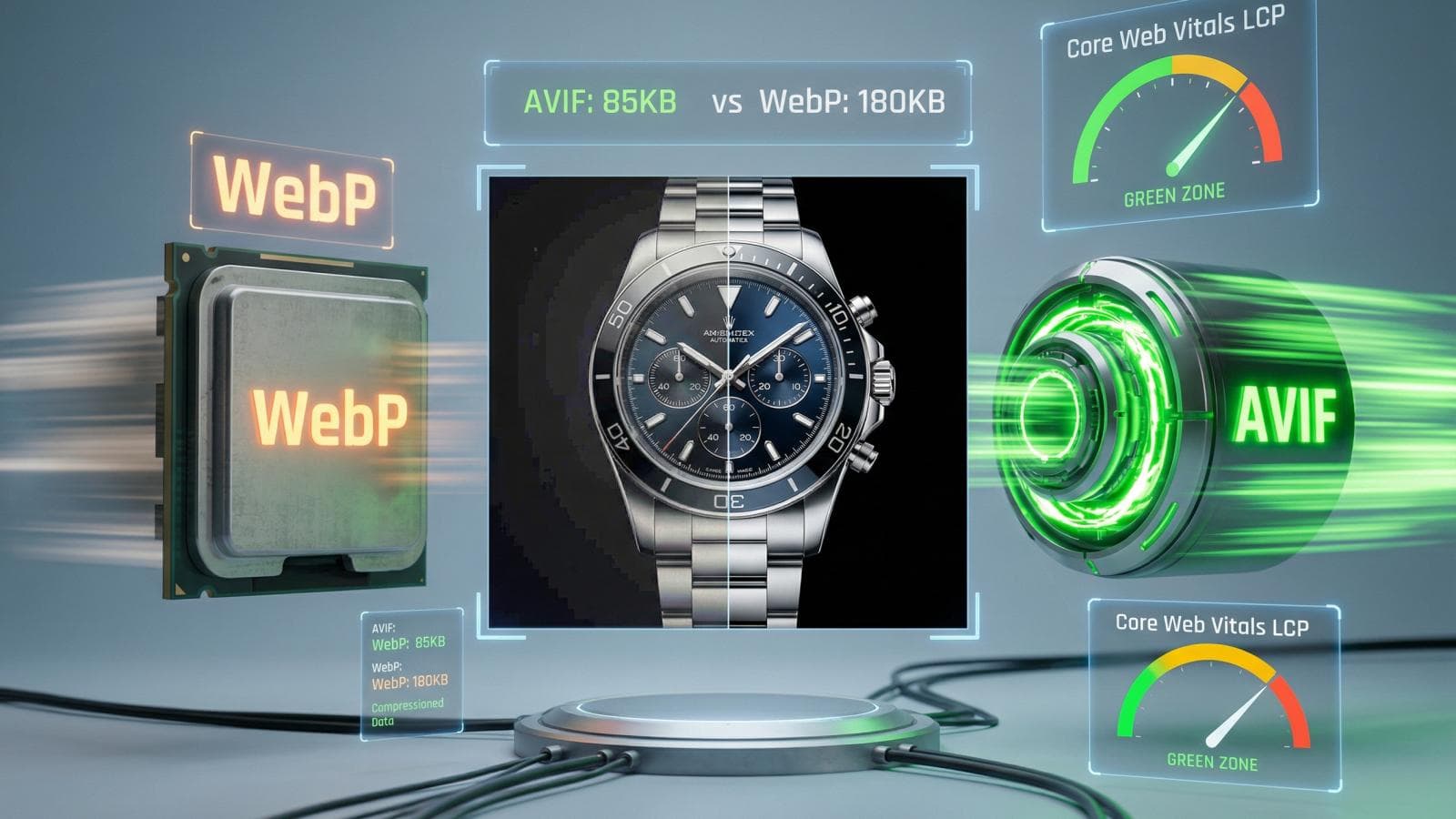
The Result: AVIF reduced the file size by more than half compared to WebP. In a mobile-first market like Mumbai, where network latency can fluctuate, saving 165 KB on a single image is the difference between an "instant" load and a "loading..." spinner.
2. Visual Fidelity (The "Artifact" Test)
One of the major weaknesses of WebP is "blocking" and "banding" in dark gradients or high-detail textures (like leather or jewelry).
WebP: At high compression, fine details often look "smudged."
AVIF: Maintains sharp edges and high-frequency details. More importantly, AVIF supports 10-bit and 12-bit color depth, whereas WebP is limited to 8-bit.
E-commerce Impact: If you sell luxury goods, AVIF preserves the "premium" feel of the product photography that WebP’s compression often flattens.
3. Alpha Transparency (The PNG Killer)
Both formats support transparency. However, WebP’s alpha channel often results in "fringing" around the edges of transparent objects. AVIF handles alpha channels with surgical precision, making it perfect for Custom Shopify Sections that feature floating products or overlapping UI elements.
Part III: Impact on Core Web Vitals (INP & LCP)
In 2026, Google’s algorithm doesn't just look at how fast an image downloads; it looks at how much work the CPU has to do to render it.
Largest Contentful Paint (LCP)
Because AVIF files are significantly smaller, they reach the user's device faster. This directly lowers your LCP. For a merchant, this means your "Above the Fold" content is ready in a heartbeat, reducing bounce rates.
Interaction to Next Paint (INP)
Large images often cause "Main Thread Blocking." While the browser is busy decoding a heavy image, it cannot respond to user clicks or scrolls.
The 2026 Advantage: Most modern mobile devices now feature hardware-accelerated AV1 decoding. This means the phone’s GPU handles the heavy lifting of rendering an AVIF image, leaving the CPU free to handle user interactions. This keeps your INP scores in the "Green" zone.
Part IV: The Business Case for AVIF Transition
At Prateeksha, we don't optimize just for the sake of speed; we optimize for revenue.
1. Massive Bandwidth Savings
For stores with high traffic (100k+ sessions/month), the shift from WebP to AVIF can reduce CDN egress costs by 30-40%. This is a direct saving that improves your bottom line.
2. Conversion Rate Optimization (CRO)
Data from 2026 retail benchmarks shows that for every 100ms you shave off your load time, conversion rates increase by 1.2%. Moving from WebP to AVIF is an "easy win" that provides an immediate lift in sales without changing a single line of marketing copy.
3. The "Eco-Commerce" Factor
In 2026, digital sustainability is a major brand value. Smaller images require less energy to transmit and store. Transitioning to AVIF is a measurable way for brands to reduce their carbon footprint, an increasingly important factor for Gen Z and Gen Alpha consumers.
Part V: Implementation Strategy for 2026
You don't need to manually re-upload every image. The modern way to implement AVIF is through Content Negotiation.
The Picture Element Approach
This is the safest way to serve next-gen formats while maintaining fallbacks for legacy systems:
HTML<picture> <source srcset="product-hero.avif" type="image/avif"> <source srcset="product-hero.webp" type="image/webp"> <img src="product-hero.jpg" alt="Luxury Handbag" loading="lazy" width="800" height="600"></picture>Automated Cloud Transformation
At Prateeksha, we typically recommend using a CDN-level optimizer (like Cloudflare, Cloudinary, or Imgix). These services detect the user's browser in real-time. If the browser supports AVIF, it serves it. If not, it serves WebP. This ensures 100% compatibility with 0% manual effort.
Part VI: Why Prateeksha is the Partner for Your Performance Journey
Optimizing images is a science, not a checkbox. When you partner with Prateeksha, we go deeper than just file extensions:
Contextual Sizing: We ensure your Custom Shopify Sections serve different image sizes based on the user's screen resolution (Retina vs. Standard).
Priority Hints: We use
fetchpriority="high"on your AVIF hero images to ensure they are the very first thing the browser downloads.Mumbai-Local Performance: We optimize specifically for the mobile network conditions found in Mumbai and India, ensuring your store is fast even on 4G connections in dense urban areas.
Conclusion: The Verdict is Clear
While WebP was the hero of the last decade, AVIF is the future of e-commerce. It offers better compression, superior color depth, and faster rendering on modern devices.
In 2026, the digital divide is defined by speed. A store that loads in 1 second isn't just "faster" than a store that loads in 3 seconds—it is more profitable, more visible in search, and more trusted by customers.
Is your store's performance being weighed down by yesterday's image formats?
Contact Prateeksha today for a 2026 Performance Audit. We will help you migrate your entire image library to AVIF, crush your Core Web Vitals, and unlock the next level of e-commerce growth.