Shopify for Jewellery Brands: The 2026 Design Guide
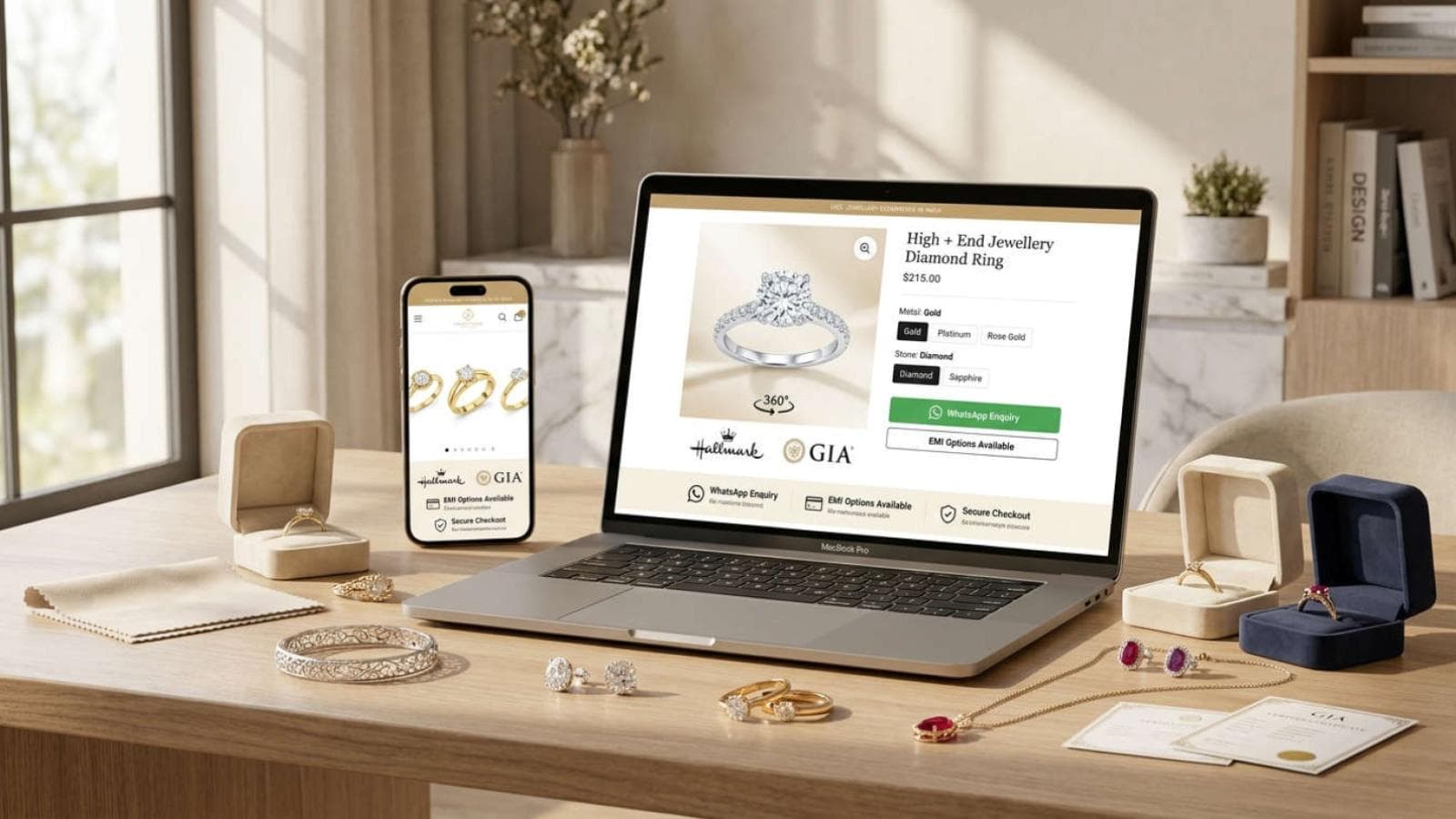
Jewellery is one of the hardest categories to sell online. The customer cannot hold the piece, cannot see the lustre under natural light, and is being asked to spend ₹15,000–₹2,00,000 or more based entirely on what they experience on a screen. Shopify, built correctly for jewellery, solves each of these problems: rich product pages with zoom and 360-degree views, variant management that handles gold, silver, and platinum across every karat and stone combination, and a checkout flow built for high-AOV anxiety. This guide covers everything an Indian jewellery brand needs to know to build a Shopify store that earns trust and converts.
Jewellery is one of the hardest categories to sell online. The customer cannot hold the piece, cannot see the lustre under natural light, and is being asked to spend ₹15,000–₹2,00,000 or more based entirely on what they experience on a screen. Shopify, built correctly for jewellery, solves each of these problems: rich product pages with zoom and 360-degree views, variant management that handles gold, silver, and platinum across every karat and stone combination, and a checkout flow built for high-AOV anxiety. This guide covers everything an Indian jewellery brand needs to know to build a Shopify store that earns trust and converts.
Why Shopify Is the Best Platform for Jewellery Brands
Shopify's architecture suits jewellery DTC better than any other platform. Three specific capabilities make the difference.
Product photography is a first-class citizen. Shopify's native product page supports multiple images, per-variant image switching, native zoom, and — with the right theme or app — 360-degree spin views. For jewellery, where the customer is buying entirely on visual trust, this matters more than almost any other platform feature. When a ring image loads in 1.2 seconds, zooms to show the setting detail, and switches instantly between white gold and yellow gold, you have closed half the trust gap that separates browsing from buying.
Variant management handles jewellery's complexity natively. A single ring SKU might exist in 18K gold, 22K gold, 925 silver, and platinum, each with five stone options and three sizes — that's 60 combinations. Shopify's variant system handles up to three variant types natively (metal, stone, size) and with apps like Infinite Options or Easify, handles any number of additional attributes cleanly. No other platform at Shopify's price point manages this without custom development.
High-AOV checkout optimisation is built in. Shopify's checkout is the most conversion-tested checkout on the internet. For jewellery brands selling at ₹20,000–₹2,00,000+, Shopify's trust badges, EMI integrations (Simpl, LazyPay, ZestMoney), multi-step progress, and express payment options (UPI, Razorpay, Shop Pay) reduce the friction that kills high-ticket purchases. Abandonment rate at checkout is systematically lower on Shopify than on WooCommerce or custom platforms because Shopify invests millions of dollars annually in checkout CRO research.
The Unique Challenges of Selling Jewellery Online
Every jewellery brand faces four challenges that do not apply to lower-ticket categories. A well-built Shopify store addresses all four directly.
Trust is the primary purchase barrier. At ₹50,000 for a diamond set, the customer needs to trust the purity, the certification, the return policy, and the brand behind the transaction before they will add to cart. Trust signals are not cosmetic — they are structural. If your product page does not display BIS hallmark information, gemstone certificate references, and a clearly stated return policy within the first scroll, a significant proportion of visitors will leave without converting regardless of how attractive the product is.
High-AOV anxiety is real and specific. Customers spending ₹50,000+ online exhibit measurable anxiety behaviours: they visit multiple times over days, they check the brand on Instagram, they read reviews carefully, and they frequently want to speak with someone before purchasing. Your Shopify store needs to address this with WhatsApp integration for pre-purchase queries, a clear returns and exchange policy displayed prominently, and — for high-value pieces — an option to view the piece in person or via video call.
Customisation requests are high-frequency. Jewellery customers frequently want adjustments: a ring in a different metal, a necklace in a longer chain, a piece with a different stone, or personalised engraving. If your store cannot capture these requests cleanly — with a line item property field or a custom order request form — you will lose customers who want to buy but cannot match a standard SKU. Every missed customisation request is a missed sale.
Certificate and hallmarking information needs to be scannable. Customers making large purchases want to verify authenticity before and after purchase. Your product pages should display hallmark purity (916 for 22K, 750 for 18K, 925 for silver), gemstone certification body (GIA, IGI, SGL), and a downloadable certificate for certified pieces. Displaying this information clearly in the product page — not buried in a FAQ tab — reduces hesitation significantly.
6 Essential Shopify Features for Jewellery Stores
1. Product Page With Zoom and 360-Degree View
The product page is where jewellery is sold or lost. Your Shopify product page needs at minimum: a main image with pinch-to-zoom on mobile and scroll-to-zoom on desktop, a minimum of six images per product (front, back, side, clasp detail, on-model, and scale reference), and a video or 360-degree spin view for pieces above ₹30,000. Themes like Prestige and Crave include native zoom. For 360-degree spin functionality, the Spin-a-Sale or Magic360 apps integrate cleanly with Shopify's product page without slowing load time.
Image quality is non-negotiable. Jewellery photography needs consistent background (white or matte black depending on metal tone), macro detail shots that show stone faceting and setting quality, and on-model shots at real scale. Invest in this before any other marketing spend — the product page converts only as well as the photography allows.
2. Variant Management for Metal, Stone, and Size
A well-built Shopify variant setup for jewellery works like this: the primary variant type is metal (18K Yellow Gold, 18K White Gold, 22K Gold, 925 Silver, Platinum), the secondary variant type is stone (Diamond, Ruby, Emerald, Sapphire, No Stone), and the third variant type is size (ring size or chain length). Each combination gets its own image set — when a customer selects White Gold + Diamond, the product images switch to show exactly that combination, not the default gold version.
For combinations beyond Shopify's native three-variant limit, use Infinite Options or Easify Product Options. Both apps maintain a clean product page UI while supporting additional attributes like karat purity, certificate type, or finish (polished, matte, hammered). Variant price adjustments — charging more for platinum than silver, or for a larger stone — are handled natively in Shopify's variant pricing and with price adjustment add-ons for custom option values.
3. Custom Order and Engraving Request Flow
Personalisation drives jewellery purchases, especially in the gifting category. Your Shopify product pages should include a text input field for engraving or personalisation, clearly labelled with character limits, a preview where possible, and the engraving charge (if applicable) shown transparently on the page — not added as a surprise at checkout. Shopify's native line item properties handle this for simple engraving. For more complex personalisation — font choice, placement, multi-line text — Easify Product Options provides a live preview builder that integrates with standard Shopify checkout.
For fully bespoke orders (custom-designed pieces, wedding sets, corporate gifting), add a custom order request form that captures the customer's brief, budget, timeline, and contact details, then routes to your WhatsApp or CRM. This should be accessible from every product page via a secondary CTA alongside the main add-to-cart button.
4. Trust Signals: Hallmark, Certificate, and Return Policy
Trust signals on a jewellery product page are structural elements, not decorative. Place them within the first viewport on desktop and within two scrolls on mobile. The essentials are: BIS hallmark purity displayed as a badge (916, 750, 925), gemstone certification reference (GIA certificate number or IGI report number for certified pieces), a downloadable certificate link for high-value pieces, and your returns policy stated in plain language — not linked to a separate page that requires an extra click.
Add a trust bar below the product images with four to five icons: hallmark verified, certified stones, free insured shipping, easy returns, and expert WhatsApp support. These icons with short one-line descriptions have a measurable impact on add-to-cart rate for purchases above ₹25,000 because they address the specific anxieties that stop jewellery purchases.
5. WhatsApp Integration for Pre-Purchase Queries
WhatsApp is India's primary customer service channel for high-involvement purchases. For jewellery, where customers regularly have questions about purity, sizing, customisation, and certification before committing to a high-value purchase, WhatsApp integration is not optional — it is a conversion tool. Add a WhatsApp widget that floats persistently on product pages and collection pages, pre-populated with a contextual message: "I'd like to know more about [Product Name]" so the customer does not have to type from scratch.
Tidio's WhatsApp integration, WATI, and Interakt all work cleanly with Shopify. The key configuration is: auto-trigger the WhatsApp widget after 30 seconds on a product page above a price threshold (e.g. ₹30,000+), set up automated responses for common pre-purchase questions (sizing guides, hallmark purity, return windows), and ensure the widget does not interrupt the add-to-cart flow on mobile — it should be a floating button, not a popup.
6. Collections for Gifting and Occasions
Jewellery purchases are event-driven: wedding, anniversary, Dhanteras, Diwali, Valentine's Day, birthday, graduation. Organising your Shopify collections by occasion alongside the standard metal and category taxonomy doubles your discoverability and makes gifting decisions dramatically easier. Create smart collections for Wedding Jewellery, Anniversary Gifts, Gifts Under ₹10,000, Gifts Under ₹25,000, Festive Collection, and New Arrivals. These collections can be promoted via the homepage, email campaigns, and WhatsApp broadcasts aligned to the calendar.
Gifting-specific features worth adding: a gift message field at checkout, gift box packaging as a product or add-on option, and a curated gift finder page (a short quiz that recommends pieces based on the recipient, occasion, and budget). Gift finders built with Shopify quizzes (Octane AI, Shop Quiz) show conversion rates 15–25% above standard collection browsing for the gifting segment.
Design Principles for Jewellery Shopify Themes
Jewellery design is not simply about looking luxurious — it is about making the product the uncontested focal point of every page. Every design decision should be evaluated against one question: does this make the jewellery more or less visible?
Background choice. For yellow gold and warm-toned pieces, a warm white or off-white background (not pure #FFFFFF) renders the metal most accurately. For white gold, silver, and platinum, a matte black or deep charcoal background creates the contrast that makes the metal appear most luminous. Many jewellery brands use white backgrounds throughout and miss the rendering advantage that a dark background gives to white metals. A theme that allows per-collection background logic — warm white for the gold collection, deep black for the silver and platinum collection — is worth the extra development investment.
Typography. High-end jewellery calls for serif typography for headings (Cormorant Garamond, Playfair Display, or EB Garamond) paired with a clean sans-serif for body text and UI elements (Inter, DM Sans). Avoid script fonts beyond narrow accent use — they reduce readability and do not render well on mobile at body text sizes. Font weight should be restrained: light to regular for product names, never bold for jewellery piece titles. The piece name should feel considered, not shouted.
Imagery standards. Every image on the site should meet a consistent quality standard: white or controlled background for product images, professional lighting, minimum 1500px on the longest edge for desktop zoom, and consistent aspect ratio across the collection (typically 1:1 for catalogue images and 4:5 for editorial and collection banners). On-model images should show the piece at realistic scale on different skin tones where possible — this reduces the single biggest post-purchase complaint in jewellery e-commerce, which is "it looked bigger/smaller than I expected".
White space is a luxury signal. Crowded product pages read as low-end regardless of product quality. Give each product image generous breathing room, keep the product description concise and scannable, and use visual hierarchy — product name, price, variant selector, trust signals, add to cart — in a clear vertical flow with no competing elements. Every element that does not contribute directly to the purchase decision should be removed from the product page.
Building a Shopify store for your jewellery brand? Prateeksha Web Design specialises in Shopify design and development for jewellery and luxury brands in India. We handle everything from product page architecture to trust signal implementation to WhatsApp integration. See what we deliver for jewellery brands.
See Our Jewellery Shopify WorkRecommended Apps for Jewellery Shopify Stores
Three apps deliver the highest return on investment specifically for jewellery DTC brands.
Loox for photo reviews. Social proof is critical for high-AOV jewellery purchases, and photo reviews are the most trusted form of social proof because they show the piece on a real person at real scale. Loox sends automated review request emails with photo prompts 7–14 days after delivery (enough time for the customer to have worn the piece), displays photo reviews in a carousel on product pages, and adds a star rating to collection page tiles. For jewellery, the single most valuable review element is a clear photo of the piece being worn — Loox is built around collecting exactly that. Average increase in conversion rate from Loox photo reviews for jewellery brands in our experience is 8–15% on product pages that previously had no reviews.
ReConvert for post-purchase upsells. Jewellery presents strong upsell opportunities at the thank you page stage: a customer who has just purchased a ring is a high-probability buyer of matching earrings or a cleaning kit. ReConvert allows you to configure the post-purchase thank you page with a one-click upsell offer (no re-entry of payment details required on Shopify Plus), a birthday date capture for future campaigns, and a personalised product recommendation carousel. For jewellery, post-purchase upsell revenue via ReConvert typically adds 4–8% to total monthly revenue without any additional customer acquisition cost.
Tidio for live chat and WhatsApp. Tidio combines live chat, chatbot automation, and WhatsApp in a single interface, which makes it the most practical option for jewellery brands managing pre-purchase conversations across channels. The chatbot handles frequently asked questions (sizing guide, hallmark details, return window) automatically outside business hours. Live chat and WhatsApp routing go to the same inbox so no conversation is missed. For jewellery brands receiving significant pre-purchase query volume — particularly around weddings, Dhanteras, and festive seasons — Tidio prevents lost sales from unanswered queries and reduces the team overhead of managing WhatsApp manually.
Editorial Design in Practice: Lessons from Luxury Retail
When Prateeksha Web Design built the Shopify presence for Sanchi Velvets, a luxury fabric and fashion brand, the core design challenge was identical to the one jewellery brands face: how do you convey material quality and craftsmanship on a screen, to a customer who cannot touch the product? Our approach was to make texture the hero — full-bleed editorial images that filled the viewport, close-up fabric detail shots with scroll-triggered zoom, and a product page architecture where the imagery led and the copy supported rather than the reverse.
The same principle applies directly to jewellery. A bracelet's hand-hammered finish, a ring's pavé setting, a necklace's chain articulation — these details are the purchase decision. They need to be visible at the scale and resolution that makes the craftsmanship legible. When we translate this to jewellery Shopify builds, we apply the same editorial discipline: product images that take up 55–60% of the above-the-fold viewport on desktop, macro detail shots as a dedicated scroll section below the variant selector, and a single consistent visual language across the entire collection rather than a patchwork of photography styles from different product shoots.
The result is a store that reads as premium before the customer has read a word of copy — because the visual execution signals quality before any text does.
If you want the same editorial standard applied to your jewellery Shopify store, get in touch and we'll scope the project with you.
Frequently Asked Questions
Is Shopify good for selling jewellery online in India?
Yes. Shopify is the leading platform for jewellery DTC brands globally and in India. Its native variant system handles metal type, karat, stone, and size combinations without custom development. The theme ecosystem includes jewellery-optimised layouts with zoom and 360-degree image support built in. Shopify's checkout supports EMI and buy-now-pay-later options via Simpl, ZestMoney, and LazyPay, and integrates natively with WhatsApp for pre-purchase queries — all of which matter specifically for high-AOV jewellery purchases.
How do I show hallmark and certificate information on a Shopify jewellery product page?
The most effective approach is a dedicated trust section on the product page using metafields or a custom theme section. Add structured fields for BIS hallmark number, purity (916 for 22K, 750 for 18K, 925 for silver), gemstone certificate reference (GIA, IGI, SGL), and a downloadable certificate link for certified pieces. Display these as icon-plus-text badges placed near the add-to-cart button — the closer they are to the purchase action, the more directly they reduce checkout anxiety. A sticky trust bar at the bottom of the mobile screen showing hallmark and return policy icons reinforces this on scroll.
What is the best Shopify theme for an Indian jewellery brand?
Prestige and Crave are the two most-used premium Shopify themes among jewellery brands, both offering editorial layouts, full-bleed imagery, and zoom-native product pages. Both handle multi-image variants cleanly and support collection page filters suited to jewellery browsing. A custom Shopify theme built specifically for your brand gives full control over product page layout, trust signal placement, and mobile experience — and for jewellery brands where product photography is the primary selling tool, that control is worth the investment.
How do I handle custom engraving or personalisation requests on Shopify?
Shopify's native line item properties allow you to add a text input field directly on the product page, labelled with the engraving instructions, character limits, and any additional charge. This data flows through to the cart, order, and fulfilment notifications automatically. For more complex personalisation — font choice, placement options, multi-line text with live preview — Easify Product Options and Infinite Options extend this capability without requiring custom development. Always display the personalisation charge transparently on the product page and confirm the exact text in the order confirmation email before fulfilment begins.
How much does it cost to build a Shopify jewellery store in India?
A Shopify jewellery store built on a premium theme with full configuration, app setup, and launch support costs ₹75,000–₹2,00,000 from a quality Indian agency. A fully custom Shopify theme designed specifically for your brand's editorial aesthetic and jewellery-specific product page features — zoom, variant image switching, trust signal architecture, WhatsApp integration — runs ₹2,50,000–₹8,00,000. Ongoing retainer support for CRO testing, new collection launches, and app management runs ₹30,000–₹1,20,000 per month. See our jewellery Shopify services for what Prateeksha delivers at each tier.