Shopify App Integration Guide: What DTC Brands Actually Need in 2026
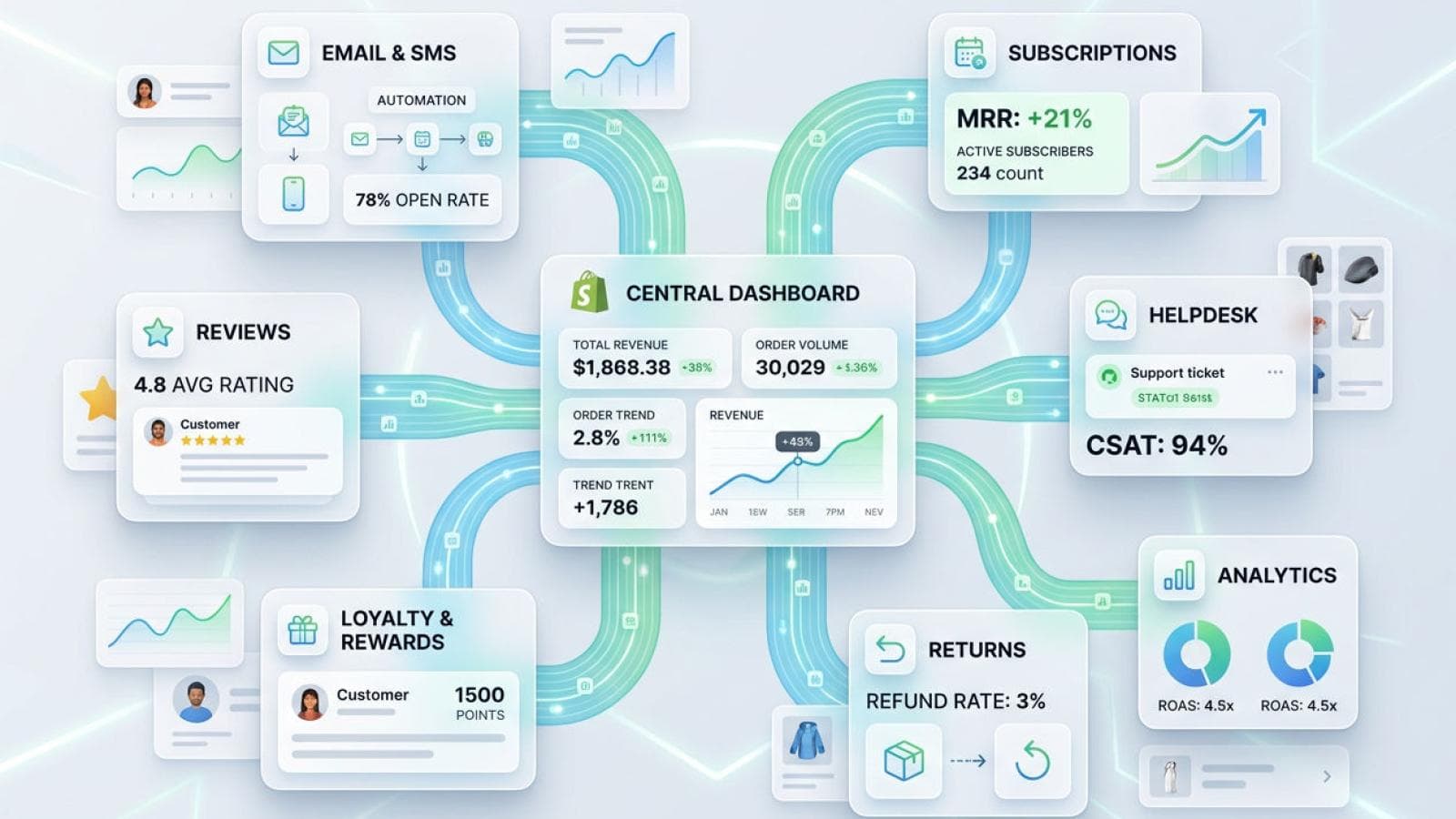
Shopify app integration services are the fastest lever a DTC brand has to increase customer lifetime value without rebuilding their store. The average Shopify Plus store runs 30–40 apps, but high-performing brands cap their active stack at 12–18 carefully chosen tools. This guide covers the seven-category app stack Prateeksha Web Design recommends, how to set each one up, and when a custom private app beats an off-the-shelf one.
Shopify app integration services are the fastest lever a DTC brand has to increase customer lifetime value without rebuilding their store. The average Shopify Plus store runs 30–40 apps, but high-performing brands cap their active stack at 12–18 carefully chosen tools. This guide covers the seven-category app stack Prateeksha Web Design recommends, how to set each one up, and when a custom private app beats an off-the-shelf one.
Why Your Shopify App Stack Determines Your Revenue Ceiling
A Shopify store's app stack is not a support function — it is a revenue architecture. Shopify's 2025 Commerce Trends report found that brands using a fully integrated retention stack (email + reviews + loyalty + subscriptions) generated 42% higher revenue per customer than stores relying on Shopify's native defaults alone. The gap widens as the brand scales.
The problem is that most DTC founders approach app selection the wrong way: they install an app when a problem surfaces, rather than designing the stack proactively. This creates conflicts, data silos, and performance bottlenecks. App integration is an architectural decision, not a plugin exercise.
Prateeksha Web Design integrates the full DTC app stack for Shopify stores in seven structured categories. Each category feeds data into the next — Klaviyo reads Recharge subscription events, Gorgias surfaces Yotpo review alerts, and Triple Whale ties all revenue attribution together. Build the stack in this order and every layer amplifies the one before it.
Need an expert to audit and integrate your Shopify app stack? Prateeksha Web Design specialises in end-to-end Shopify app integration services for DTC brands worldwide.
Get a Free Stack AuditEmail Marketing: Klaviyo Is the Non-Negotiable
Klaviyo is the email and SMS marketing platform that powers over 150,000 Shopify stores globally and generates an average email ROI of $45 for every $1 spent, according to Klaviyo's own 2024 benchmark report. No other platform comes close for Shopify-native segmentation, predictive analytics, or pre-built Shopify flow triggers.
The correct Klaviyo integration for a Shopify DTC brand includes:
- Install Klaviyo via the official Shopify App Store listing — this activates the server-side data sync.
- Enable Klaviyo's Shopify pixel (replacing the legacy JavaScript snippet) for sub-100ms event capture.
- Activate the five core flows: Welcome Series, Abandoned Cart, Browse Abandonment, Post-Purchase, and Win-Back.
- Connect Recharge (subscriptions) and Yotpo/Judge.me (reviews) as Klaviyo data sources for behavioural triggers.
- Set up SMS compliance flows if targeting US customers — TCPA compliance is non-negotiable.
Klaviyo's predictive CLV model alone is worth the integration effort. It assigns a predicted 90-day and 365-day revenue value to every contact, enabling you to suppress low-value contacts from campaigns before they inflate your plan cost.
Reviews and Social Proof: Yotpo vs Judge.me
Social proof is the single highest-ROI content type on a Shopify product page. Spiegel Research Center data shows that displaying five or more reviews increases the likelihood of purchase by 270%. The two dominant review apps for Shopify DTC brands are Yotpo and Judge.me, and the right choice depends on revenue stage and marketing sophistication.
Yotpo is the enterprise-grade choice. It includes review syndication to Google Shopping, UGC (photo and video) reviews, SMS marketing via Yotpo SMSBump, and a native integration with Klaviyo, LoyaltyLion, and Gorgias. Pricing starts at $119/month and scales with order volume. Yotpo is the right tool for brands doing $1M+ per year that need review data to flow across multiple marketing channels.
Judge.me is the smart choice for brands under $500K in annual revenue. The free plan supports unlimited review requests, photo reviews, and Shopify-native display widgets. The paid plan at $15/month adds Google Shopping review syndication, custom Q&A, and advanced display options. Judge.me integrates cleanly with Klaviyo through webhooks and is significantly lighter on page load than Yotpo.
Learn how the Shopify power trio of Klaviyo, Recharge and Yotpo works together as a unified retention engine — the data flow between these three apps is where most DTC brands leave money on the table.
Subscriptions: Recharge Is Still the Market Leader
Recharge Payments powers subscriptions for over 20,000 Shopify merchants and processes more than $5 billion in subscription revenue annually, making it the default choice for any DTC brand launching a subscribe-and-save or box subscription model. Subscription customers have a 300% higher lifetime value than one-time purchasers on average, according to Recharge's 2024 State of Subscription Commerce report.
Setting up Recharge correctly on Shopify requires attention to four integration points:
- Product configuration: Tag subscription-eligible products and set default interval options (weekly, monthly, bi-monthly) directly in Recharge's product rules.
- Klaviyo connection: Activate the Recharge–Klaviyo integration to send subscription lifecycle events (created, skipped, cancelled, renewed) into Klaviyo flows.
- Customer portal: Customise the Recharge customer portal to match your Shopify theme — the default portal is functional but generic and hurts brand trust.
- Dunning logic: Configure Recharge's payment retry schedule and Klaviyo dunning flows for failed payment recovery — this alone recovers 8–12% of churned subscribers.
Competitors like Skio and Stay Ai are gaining ground in the subscription space with better UX and native A/B testing, but Recharge remains the safest default for first-time subscription launches due to its depth of Shopify documentation and partner support ecosystem.
Loyalty Programs: LoyaltyLion vs Smile.io
Loyalty programs increase purchase frequency by an average of 20% and reduce paid acquisition costs for returning customers by 35–50%, according to Loyalty360's 2024 industry benchmarks. The two most widely deployed loyalty apps on Shopify are LoyaltyLion and Smile.io.
LoyaltyLion is the premium choice, with deep integrations into Klaviyo (triggering emails based on point milestones), Gorgias (surfacing loyalty tier in agent view), Recharge (awarding points on subscription renewals), and Yotpo (double points on review submissions). Pricing starts at $399/month — it is built for brands with large returning customer bases where cross-channel loyalty data delivers meaningful lift.
Smile.io covers points, referrals, and VIP tiers at a much lower entry price (free plan available, paid from $49/month). Smile.io's Shopify integration is plug-and-play and works well for brands that want a visible loyalty widget without deep cross-app data flows. The limitation is that Smile.io's Klaviyo integration is less granular than LoyaltyLion's — you get fewer trigger events and less segmentation depth.
For most DTC brands in their first two years, Smile.io delivers 80% of the loyalty benefit at 10% of the cost. Switch to LoyaltyLion when your returning customer rate exceeds 30% of monthly orders and you want loyalty data driving Klaviyo segmentation.
Helpdesk and CX: Gorgias Cuts Support Volume by 30%
Gorgias is the Shopify-native helpdesk that centralises email, live chat, Instagram DMs, Facebook Messenger, WhatsApp, and SMS into a single support queue. Gorgias reports that merchants using its automation rules reduce first-response time by 46% and resolve up to 30% of tickets without any human intervention, according to Gorgias's 2024 customer data.
The Gorgias integration for a Shopify DTC brand works best when configured with:
- Order management macros: Pre-built responses for WISMO (Where Is My Order), cancellations, and address changes that pull live order data from Shopify directly into the reply window.
- Yotpo/Judge.me connector: Surface the customer's review history and star rating in the Gorgias ticket sidebar — agents see context without switching tabs.
- LoyaltyLion or Smile.io widget: Show the customer's loyalty points balance in the Gorgias sidebar so agents can offer a points bonus during a complaint resolution.
- Recharge panel: Allow agents to skip, pause, or modify a customer's subscription directly from Gorgias — removing the need to log into Recharge separately.
- Revenue tracking: Enable Gorgias Revenue Statistics to measure support-driven sales, which average $500–$2,500/month for active DTC brands in chat interactions alone.
Returns Management: Loop Reduces Refund Loss
Loop Returns is the leading returns and exchanges platform for Shopify, processing over 4 million returns per month across more than 3,500 brands globally. Loop's own data shows that brands offering Instant Exchange (exchange before the return is received) retain 60% of revenue that would otherwise be lost to refunds.
A well-configured Loop integration on Shopify replaces the generic returns process with a branded self-service portal that:
- Lets customers initiate returns and exchanges without contacting support — reducing Gorgias ticket volume by 20–35% for return-heavy categories like apparel and footwear.
- Routes exchange-eligible returns to Shopify as a new draft order automatically, keeping revenue in the brand's ecosystem.
- Syncs return data to Klaviyo so you can trigger a win-back flow for customers who returned a product — targeting them with a personalised offer based on the return reason.
- Generates return analytics by SKU, return reason, and customer segment — identifying quality or sizing issues before they damage review scores.
Loop competes with AfterShip Returns and Happy Returns, but Loop's Shopify-native architecture and Instant Exchange feature give it a clear lead for apparel and footwear DTC brands in 2026.
Integrating Loop, Gorgias, Recharge, and Klaviyo into a single cohesive stack is complex — and getting the data flows wrong means broken automation and leaking revenue. Prateeksha Web Design has built this exact stack for global DTC brands. Our Shopify app integration services include full setup, testing, and documentation.
Request a Free QuoteAnalytics: Triple Whale Replaced GA4 for DTC
Triple Whale is the DTC-specific analytics platform that aggregates Shopify sales data, ad spend (Meta, Google, TikTok), email revenue (Klaviyo), and customer behaviour into a single dashboard. Triple Whale's 2024 DTC Benchmarks report — covering 5,000+ Shopify stores — found that brands using unified attribution dashboards reduced wasted ad spend by an average of 22% within the first 90 days.
Triple Whale solves the attribution problem that has plagued DTC brands since iOS 14.5 restricted Meta Pixel data. Its Pixel component captures first-party post-purchase survey data and blends it with Shopify order data to produce blended MER (Marketing Efficiency Ratio) as the north-star metric — far more reliable than last-click GA4 attribution for multi-channel DTC.
Key Triple Whale integrations to activate:
- Shopify native: Auto-syncs orders, refunds, and product data in real-time.
- Meta Ads + Google Ads: Pulls spend data to calculate true ROAS at ad set and creative level.
- Klaviyo: Attributes email-driven revenue to the correct Klaviyo flow or campaign.
- TikTok Ads: Measures TikTok's assisted conversion impact — frequently underreported by TikTok's native attribution.
Alternatives to Triple Whale include Northbeam (stronger for large media budgets over $500K/month) and Rockerbox (better for agencies managing multiple brands). For single-brand DTC stores at $500K–$10M revenue, Triple Whale is the default recommendation.
Shopify App Comparison Table: Category-by-Category
This table covers every core DTC app category, the recommended tools for each stage of growth, and the key integration priority for 2026.
| Category | Budget Pick (Under $500K revenue) | Scale Pick ($1M+ revenue) | Avg Monthly Cost (Scale) | Key Integration |
|---|---|---|---|---|
| Email & SMS | Klaviyo (Free up to 500 contacts) | Klaviyo | $150–$700+ | Recharge, Yotpo, Gorgias |
| Reviews | Judge.me ($0–$15/mo) | Yotpo | $119–$500+ | Klaviyo, Gorgias, Google Shopping |
| Subscriptions | Recharge (1% + $0.05/transaction) | Recharge / Skio | $300–$1,000+ | Klaviyo, LoyaltyLion, Gorgias |
| Loyalty | Smile.io ($0–$49/mo) | LoyaltyLion | $399–$999+ | Klaviyo, Yotpo, Recharge, Gorgias |
| Helpdesk | Gorgias (Starter $10/mo) | Gorgias | $300–$900+ | Shopify, Recharge, Loop, Yotpo |
| Returns | Loop Returns (from $59/mo) | Loop Returns | $155–$400+ | Shopify, Klaviyo, Gorgias |
| Analytics | Google Analytics 4 (Free) | Triple Whale | $299–$800+ | Shopify, Meta Ads, Klaviyo, TikTok |
Off-the-Shelf vs Custom Private Apps: When to Go Custom
Off-the-shelf Shopify apps cover 90% of what a DTC brand needs in its first $5M of revenue. Custom private apps — Shopify apps built exclusively for one store, not listed in the App Store — become the right choice in specific scenarios that off-the-shelf tools cannot handle.
Choose off-the-shelf apps when:
- Your business logic is standard (subscribe-and-save, points-based loyalty, review requests).
- You want to validate a feature before committing to custom development cost.
- Your engineering team capacity is zero or minimal.
- SaaS total cost of ownership is under $3,000/year — the break-even point for custom development.
Choose a custom Shopify private app when:
- Your pricing model is unique — B2B tiered pricing by customer account, wholesale and retail on the same store, or currency-specific pricing beyond Shopify Markets defaults.
- You need Shopify to talk to a system that has no native integration — legacy ERPs, bespoke warehouse management systems, or proprietary data warehouses.
- Off-the-shelf app API rate limits are causing sync delays that affect fulfilment speed.
- Data sovereignty or legal compliance prevents sending customer data to a third-party SaaS (relevant for EU-based brands under GDPR).
- You need Shopify admin customisations (custom metafield editors, order tagging automation, bulk product management) that no existing app provides.
Custom private app development costs $3,000–$15,000 USD for most DTC use cases and takes 4–8 weeks with a specialist agency. The breakeven on SaaS replacement typically hits in 12–18 months for stores doing over $1M per year. Prateeksha Web Design builds custom private apps for Shopify stores that have outgrown the standard ecosystem — the development starts with a detailed technical specification so the scope and cost are fixed before a line of code is written.
Frequently Asked Questions
What are the most important Shopify apps for a DTC brand in 2026?
The essential Shopify app stack for a DTC brand in 2026 covers seven categories: email marketing (Klaviyo), reviews and social proof (Yotpo or Judge.me), subscriptions (Recharge), loyalty (LoyaltyLion or Smile.io), helpdesk (Gorgias), returns management (Loop Returns), and analytics (Triple Whale). Each category directly impacts retention, conversion, and profitability. Brands that fully integrate all seven report an average 25–40% lift in customer lifetime value compared to stores using basic Shopify defaults.
How many Shopify apps is too many?
A Shopify store should run no more than 15–20 apps at any time — beyond that, theme rendering times increase and JavaScript conflicts multiply. Shopify's own Partner data shows that every additional app adds an average of 200–500ms to page load. The goal is a lean, integrated stack where each app serves a distinct revenue function, not a collection of overlapping tools.
When does a DTC brand need a custom Shopify private app instead of an off-the-shelf solution?
A DTC brand needs a custom Shopify private app when off-the-shelf solutions cannot support a unique business logic, such as a complex B2B pricing matrix, multi-warehouse inventory rules, or a proprietary loyalty currency. Custom private apps are also the right choice when a brand outgrows the API rate limits of third-party apps or when data sovereignty rules prevent using external SaaS tools. The development cost is typically $3,000–$15,000 USD but the long-term savings in SaaS fees and performance gains justify the investment for stores doing over $1M per year.
Does Klaviyo slow down a Shopify store?
Klaviyo uses an asynchronous JavaScript snippet that loads after the main page content, so it does not block rendering or hurt Core Web Vitals when installed correctly. However, triggering Klaviyo popups through heavy third-party popup apps — rather than Klaviyo's native form builder — can add render-blocking scripts. Prateeksha Web Design always integrates Klaviyo using its official Shopify integration with async loading to keep LCP under 2.5 seconds.
What is the difference between Yotpo and Judge.me for Shopify reviews?
Yotpo is a premium review and UGC platform with built-in Google Shopping review syndication, SMS marketing, and loyalty integrations — it costs from $119/month and is best for brands doing $1M+ in annual revenue. Judge.me is a lightweight, affordable alternative (free tier available, paid from $15/month) that covers core reviews, photo/video reviews, and review import from other platforms. DTC brands under $500K in revenue get full value from Judge.me; brands at scale with multi-channel marketing needs benefit from Yotpo's ecosystem.